
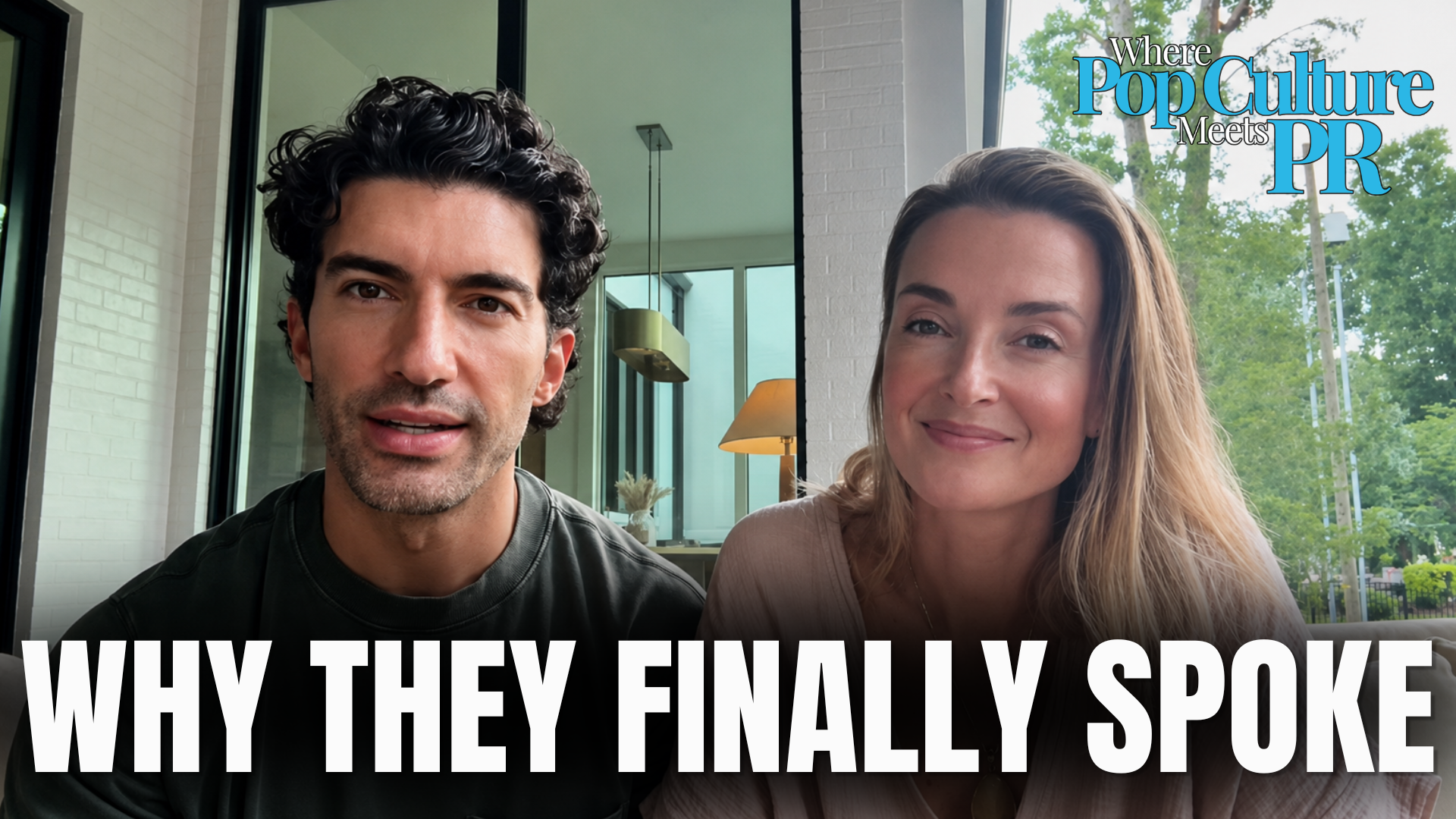
After nearly two years of saying nothing publicly, Justin Baldoni and his wife Emily Baldoni finally broke their silence.
Not with a legal deep-dive.
Not with a glossy sit-down interview.
Not with a counterattack.
Just four minutes and fifty seconds, filmed at home, sitting side by side.
And from a PR perspective, it was quietly formidable.
For two years, Baldoni did something most public figures struggle to do in a crisis: he stayed silent. While filings flew and narratives formed, he largely let his attorney speak for him. There were no reactive Instagram ‘Lives’ or stories. No emotional “my side of the story” interviews. No attempts to win the internet.
Silence, in this case, wasn’t weakness. It was timing.
They waited until the legal situation had fully closed. Only then did they speak. That matters: Once a case is over, the risk of words being weaponised drops dramatically. The window becomes safer. Cleaner. More controlled.
And what they said was just as strategic as when they said it.
They didn’t mention Blake Lively once.
They didn’t revisit evidence.
They didn’t re-litigate anything.
Instead, they reframed the entire experience emotionally.
“Gratitude has saved us.”
“Painful things have been spoken into existence — untruthful.”
“The truth and the facts have spoken for themselves.”
And then the line that will likely echo the longest, from Emily:
“How could something like this even happen… let alone disguised as a fight for women?”
It’s a striking question - left hanging. Pointed, but not defamatory. Critical, but not accusatory. It challenges the framing of the situation without naming the framer. From a communications standpoint, that’s elegant.
The overall tone was healing, not hostile. They positioned themselves not as litigants, but as a family who endured turbulence, leaned into faith, and came through it steadier. The subtext was clear: we let the process work, and now we are moving forward.
Even visually, the message was consistent. No red carpet. No stylists. No big event or engineered production. Just a garden, birdsong, and two people sitting close together. Calm. Measured. Grounded.
It could easily have been just Justin speaking. But they chose for Emily to be there — and in some moments, more front-footed than he was. That mattered. Her presence reframed the story as something that happened to a family, not just a man navigating Hollywood.
Perhaps the most interesting part of the video was the “why?” They didn’t say they needed to clear the record. They didn’t claim they had to correct misinformation. They simply said it felt like the right time.
That simplicity makes it harder to attack. It doesn’t feel like an offensive. It feels like its open ended.
When this controversy first erupted, many quietly assumed it was the end of Baldoni’s career.
Hollywood is not known for nuance in scandal. The industry protects power. And going up against an A‑list machine with deeply embedded cultural capital? That looked, on paper, like professional suicide. There was open speculation that no studio, no network, no serious collaborator would risk touching him again.
And yet — here we are.
Through restraint rather than retaliation, Baldoni has slowly repositioned himself. Not as combative. Not as aggrieved. But as composed. Measured. Steady.
In crisis communications, credibility isn’t built through volume. It’s built through consistency. Through emotional regulation. Through refusing to escalate.
Over two years, he didn’t spiral publicly. He didn’t wage a social media war. He didn’t embark on a sympathy circuit. He let the legal chapter close and then spoke calmly, briefly, and without venom.
That composure matters.
Meanwhile, the other side has remained highly visible — social posts, interviews, speeches, red carpets. Visibility brings scrutiny. And in the age of community notes and forensic internet analysis, scrutiny can quietly erode polish. The louder the messaging, the more it invites dissection. And over time, volume can begin to feel like noise.
In long-running public conflicts, perception shifts rarely happen in one dramatic moment. They happen gradually. Subtly. The steadier presence begins to look more credible. The less reactive figure begins to look more mature. The one who waited begins to look more reliable.
What once appeared to be a mismatch now has the contours of a classic asymmetry — a David versus Goliath dynamic. The smaller figure, out-resourced and out-amplified, choosing patience over power.
Because here is PR’s quiet truth: spin can dominate a cycle, but credibility shapes legacy.
The public does not always remember who spoke the loudest. They remember how they feel about a person: who seemed the most stable and unshaken when it mattered.
This video did more than offer closure. It laid foundations.
Strong.
Honest.
Credible foundations.
Many thought this would end Justin Baldoni’s career — that Hollywood would close ranks and close doors.
Instead, through composure, discipline, and the refusal to fight noise with noise, he has positioned himself as something far more valuable in an uncertain industry: dependable.
And in the long arc of reputation, dependability wins.
In the end, truth — or at least the perception of it — remains PR’s most powerful force.
And this time, patience may have been the winning strategy.
Originally published on the Where Pop Culture Meets PR Substack.
Read on Substack